By King Paysos
“AI artists are here. Cheaper, faster, louder — but who owns the sound, the face, the master?”
Let’s talk about it, because the game is changing faster than the labels can lie, and faster than most artists can even upload a song. AI walked into the music industry like, “Move… I got it from here.”
Now everybody nervous.
Artists. Labels. Engineers. Even fans.
Why? Because for the first time ever, the competition ain’t human.
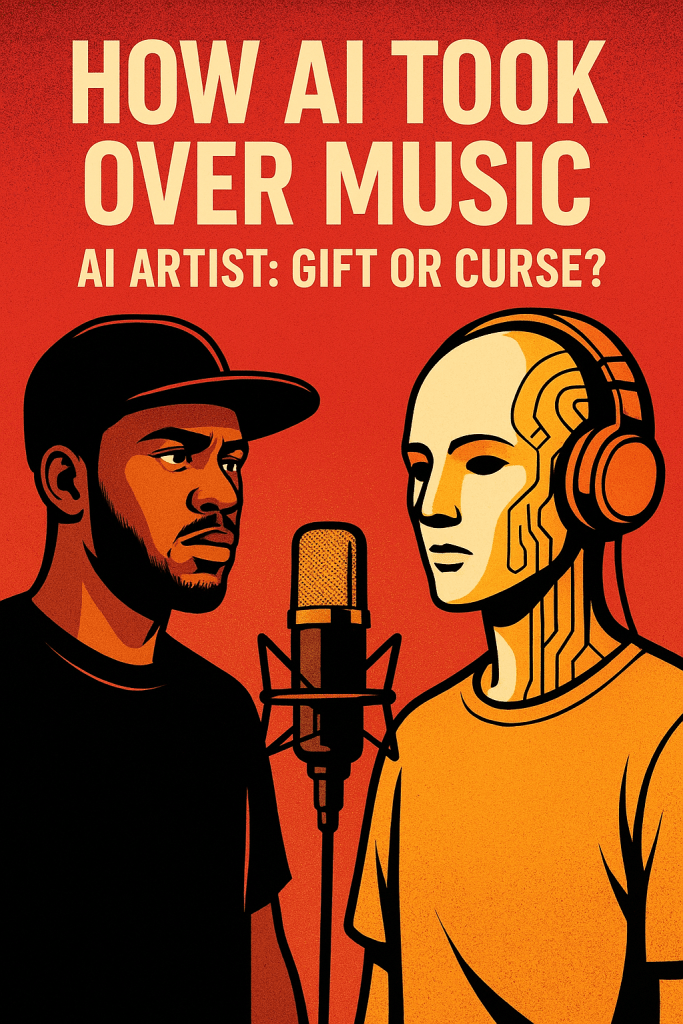
The Rise of AI Artists & Instant Production
We went from needing studios, producers, writers, and mixing engineers…
to needing a laptop and a prompt.
AI can make:
- A beat in 10 seconds
- A hook in 5
- A whole album while you’re still scrolling on TikTok
You got people making AI versions of their favorite celebrities, dropping fake collabs, and going viral like it’s nothing.
A kid in his bedroom can sound like a full-blown superstar…
…without ever learning how to do a single thing for real.
That’s the part everybody scared of:
Talent ain’t the barrier anymore. Time ain’t the barrier anymore. AI leveled the playing field and flooded it at the same time.
Ownership Battles: Likeness, Voice, Masters & Rights
Here’s where the real smoke is:
Who owns a voice?
Your voice box might be yours—but your AI voice model?
Labels want it. Companies want it. Tech platforms want it.
That’s the new “master recording.”
And if someone trains an AI on your voice, your face, your style…
and they start dropping music with your whole vibe—
Who gets paid?
Who gets sued?
Who controls it?
Right now, it’s chaos.
Artists are running into:
- Unauthorized voice clones
- Deepfake music videos using their face
- Labels trying to force AI rights into contracts
And the wild part?
Some artists are signing deals just to license their AI voice and letting the machine record for them while they chill.
It’s genius…
and dangerous as hell.
Where Human Taste Still Dominates
Here’s the part nobody wants to admit:
AI is fast.
AI is clean.
AI is impressive.
But AI has no soul.
It doesn’t know heartbreak.
It doesn’t know struggle.
It doesn’t know what it feels like to lose everything or win big.
It can imitate emotion, but it can’t live emotion.
And whether people understand it or not, the world still craves:
- Human flaws
- Human stories
- Real experiences
- Real personality
- Real presence
That’s why artists still matter.
Nobody’s lining up to see an AI perform live.
Nobody’s crying over an AI interview.
Nobody feels connected to a robot’s story.
The art isn’t the threat.
The lazy artist is the one in danger.
Because if an AI can outwork you, outpost you, outdrop you…
you gotta show the world what an AI can’t reproduce.
The Practical Playbook: How Artists Stay Winning
Let me put you onto the play:
1. Use AI — don’t let AI use you.
Let AI speed up the boring stuff:
ideas, drafts, admin work, promo, content sparks.
You still control the final product.
2. Build your face card.
Your personality is your royalty.
AI can clone your voice, not your story.
3. Protect your likeness.
Start trademarking:
- Your name
- Your tag
- Your logo
- Your vocal likeness (yes, it’s a thing now)
4. Drop more content.
Volume is the new defense.
If AI is flooding the internet, you gotta stay in front of your own wave.
5. Sell what AI can’t replace.
Community.
Energy.
Authenticity.
Live experience.
Brand power.
That’s the new game.
Final Word
AI is not the enemy.
AI is the new instrument.
But if you don’t learn it, use it, and control your narrative—
it will absolutely run you over.
The future belongs to the artist who can create with AI, not against it.
🎯 CTA / Offer
Follow for part 2 + grab the free Artist AI Survival Kit.
Your voice. Your brand. Your era.
Let’s build it the smart way.
Related Reads:
How AI Took Over Music (Part 2): The Artist Survival Blueprint


 Kingpaysos.Blog
Leave a comment